

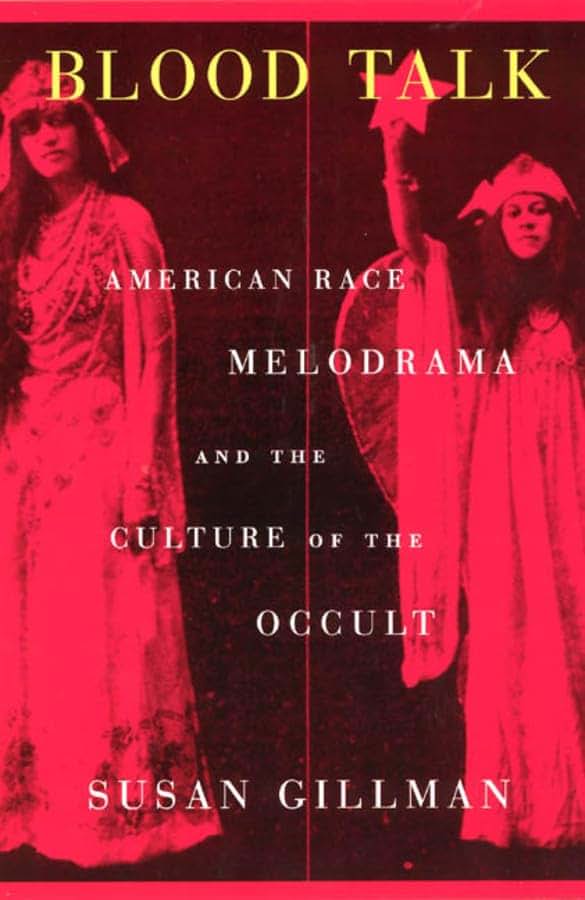
Blood Talk: American Race Melodrama and the Culture of the Occult
MIA KARTS BOOKS

- Vendor: Mia Karts
Blood Talk: American Race Melodrama and the Culture of the Occult
Book Details
- Author
- Professor Susan Gillman
- Publisher
- University of Chicago Press
- Format
- Hardcover
- Language
- English
- Category
- Criticism & Theory
- Condition
- New
- ISBN-13
- 9780226293899
- ISBN-10
- 0226293890
Free U.S. shipping on all orders. International shipping is calculated at checkout.
ISBN: 0226293890
Author: Gillman, Professor Susan
Condition: New
Product Description The United States has seldom known a period of greater social and cultural volatility, especially in terms of race relations, than the years from the end of Reconstruction to the First World War. In this highly original study, Susan Gillman explores the rise during this period of a remarkable genre-the race melodrama-and the way in which it converged with literary trends, popular history, fringe movements, and mainstream interest in supernatural phenomena. Blood Talk shows how race melodrama emerged from abolitionist works such as Uncle Tom's Cabin and surprisingly manifested itself in a set of more aesthetically and politically varied works, such as historical romances, sentimental novels, the travel literature of Mark Twain, the regional fiction of Kate Chopin and George Washington Cable, and the work of W. E. B. Du Bois. Gillman then uses the race melodrama to show how racial discourses in the United States have been entangled with occultist phenomena, from the rituals of the Ku Klux Klan and the concept of messianic second-sight to the production of conspiracy theories and studies of dreams and trances. From the Inside Flap The United States has seldom known a period of greater social and cultural volatility, especially in terms of race relations, than the years from the end of Reconstruction to the First World War. In this highly original study, Susan Gillman explores the rise during this period of a remarkable genre-the race melodrama-and the way in which it converged with literary trends, popular history, fringe movements, and mainstream interest in supernatural phenomena.Blood Talk shows how race melodrama emerged from abolitionist works such as Uncle Tom's Cabin and surprisingly manifested itself in a set of more aesthetically and politically varied works, such as historical romances, sentimental novels, the travel literature of Mark Twain, the regional fiction of Kate Chopin and George Washington Cable, and the work of W. E. B. Du Bois. Gillman then uses the race melodrama to show how racial discourses in the United States have been entangled with occultist phenomena, from the rituals of the Ku Klux Klan and the concept of messianic second-sight to the production of conspiracy theories and studies of dreams and trances. From the Back Cover The United States has seldom known a period of greater social and cultural volatility, especially in terms of race relations, than the years from the end of Reconstruction to the First World War. In this highly original study, Susan Gillman explores the rise during this period of a remarkable genre-the race melodrama-and the way in which it converged with literary trends, popular history, fringe movements, and mainstream interest in supernatural phenomena. Blood Talk shows how race melodrama emerged from abolitionist works such as Uncle Tom's Cabin and surprisingly manifested itself in a set of more aesthetically and politically varied works, such as historical romances, sentimental novels, the travel literature of Mark Twain, the regional fiction of Kate Chopin and George Washington Cable, and the work of W. E. B. Du Bois. Gillman then uses the race melodrama to show how racial discourses in the United States have been entangled with occultist phenomena, from the rituals of the Ku Klux Klan and the concept of messianic second-sight to the production of conspiracy theories and studies of dreams and trances. About the Author Susan Gillman is distinguished professor of literature and American studies at the University of California, Santa Cruz. She is the author of Blood Talk: American Race Melodrama and the Culture of the Occult, also published by the University of Chicago Press.
Have a question?
Blood Talk: American Race Melodrama and the Culture of the Occult
You May Also Like
More in Literature & Fiction