

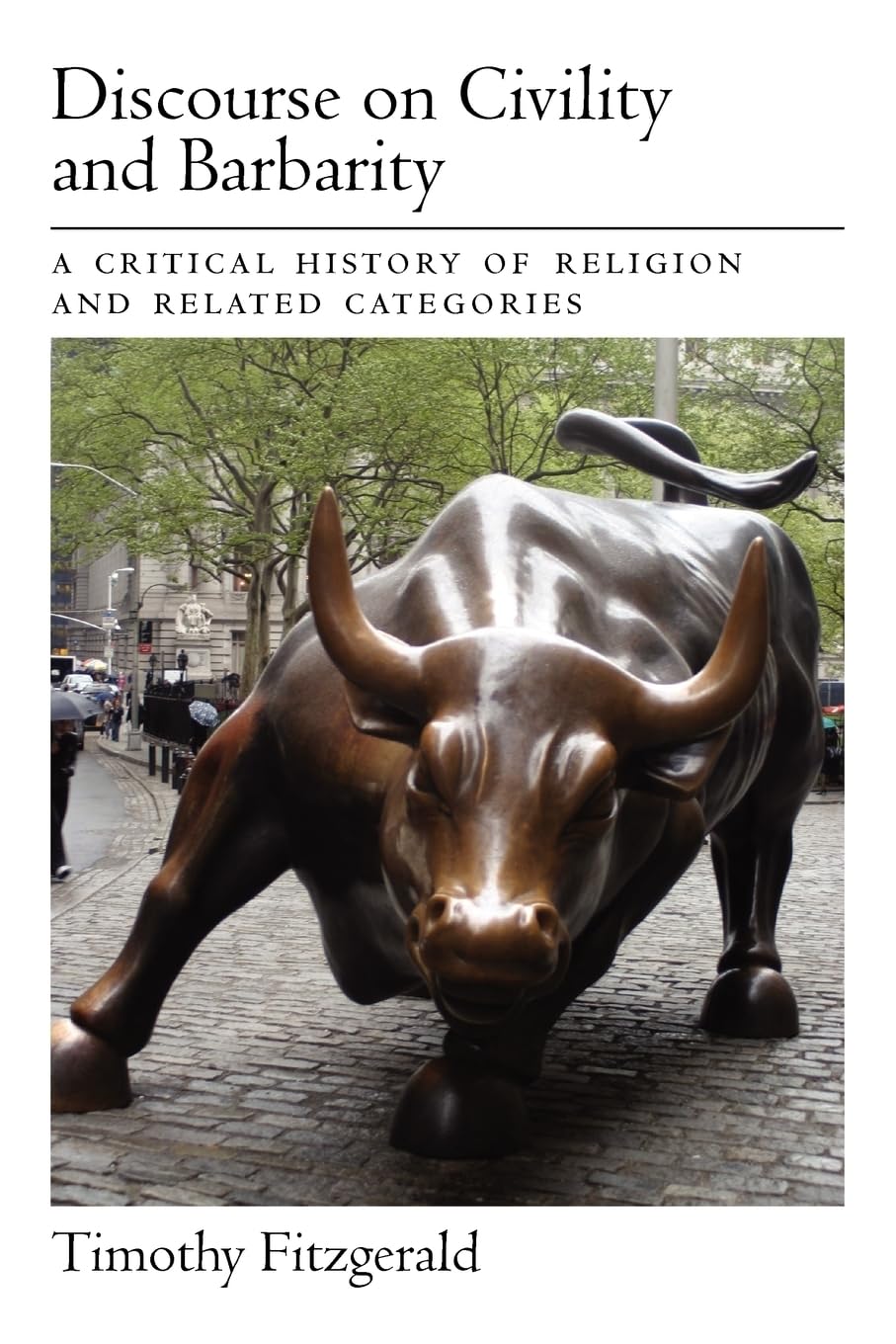
Discourse on Civility and Barbarity
MIA KARTS BOOKS

Book details
- Author
- Timothy Fitzgerald
- Publisher
- Oxford University Press
- Format
- Paperback
- Language
- English
- Category
- Education
- Condition
- New
- ISBN-13
- 9780199754601
- ISBN-10
- 0199754608
- Vendor: Mia Karts
Discourse on Civility and Barbarity
Free U.S. shipping on all orders. International shipping is calculated at checkout.
ISBN: 0199754608
Author: Fitzgerald, Timothy
Condition: New
In recent years scholars have begun to question the usefulness of the category of ''religion'' to describe a distinctive form of human experience and behavior. In his last book, The Ideology of Religious Studies (OUP 2000), Timothy Fitzgerald argued that ''religion'' was not a private area of human existence that could be separated from the public realm and that the study of religion as such was thus impossibility. In this new book he examines a wide range of English-language texts to show how religion became transformed from a very specific category indigenous to Christian culture into a universalist claim about human nature and society. These claims, he shows, are implied by and frequently explicit in theories and methods of comparative religion. But they are also tacitly reproduced throughout the humanities in the relatively indiscriminate use of ''religion'' as an a priori valid cross-cultural analytical concept, for example in historiography, sociology, and social anthropology. Fitzgerald seeks to link the argument about religion to the parallel formation of the ''non-religious'' and such dichotomies as church-state, sacred-profane, ecclesiastical-civil, spiritual-temporal, supernatural-natural, and irrational-rational. Part of his argument is that the category ''religion'' has a different logic compared to the category ''sacred,'' but the two have been consistently confused by major writers, including Durkheim and Eliade. Fitzgerald contends that ''religion'' imagined as a private belief in the supernatural was a necessary conceptual space for the simultaneous imagining of ''secular'' practices and institutions such as politics, economics, and the Nation State. The invention of ''religion'' as a universal type of experience, practice, and institution was partly the result of sacralizing new concepts of exchange, ownership, and labor practices, applying ''scientific'' rationality to human behavior, administering the colonies and classifying native institutions. In contrast, shows Fitzgerald, the sacred-profane dichotomy has a different logic of use.
Have a question?
Discourse on Civility and Barbarity
You May Also Like
More in Education & Teaching




![Stamped from the Beginning [Graphic Edition]: A Graphic History of Racist Ideas in America](http://miakarts.com/cdn/shop/files/911J8slGfQL.jpg?v=1788094489&width=400)