


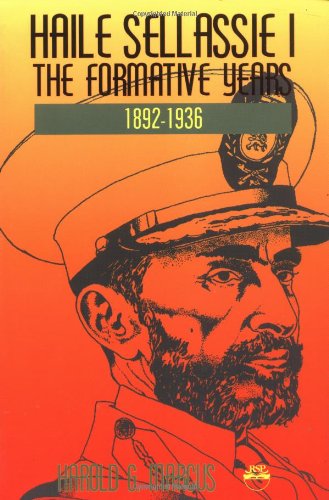
Haile Sellassie I: The Formative Years 1892-1936
MIA KARTS BOOKS

- Vendor: Mia Karts
Haile Sellassie I: The Formative Years 1892-1936
Free U.S. shipping on all orders. Free international shipping on orders over $99
All orders are dispatched the next business day!
Competitive Pricing You Can Trust — Quality You Can Rely On.
ISBN: 1569020086
Author: Marcus, Harold G.
Condition: New
His role approximated Europe's absolutist rulers of the transitional period between feudalism and capitalism. Like his Western counterparts, Haile Sellassie introduced a standing army, a permanent bureaucracy, new forms of taxation, uniform laws, and the mechanisms of a national economy. He also came to control the landed aristocracy, whose authority he redefined and whose functions he redirected to strengthen his increasingly centralized state. The emperor supported his programs through more efficient exploitation of the existing modes of agricultural production, in whose interstices merchant capitalism grew in cooperation with the ruling elites. Even though the Ethiopian absolutist social formation anticipated a more advanced method of production, it contained elements of social organization that characterized earlier centralized empires.As had the Egyptian pharaoh, the Chinese emperor, and the Persian king of kings, Haile Sellassie constructed a bureaucracy in which talent, skill, achievement, and, above all, loyalty to the ruler counted more than ethnic or social origins. The emperor's men ensured that the crown received a continuous flow of resources to maintain the machinery of royal and bureaucratic authority. Together with their patron, "they strove to concentrate in their own hands, the main centers of power and control in the country"; they codified and unified law, regularized revenue collection, and standardized administrative practices. The bureaucrats also helped to portray the ruler as the heir to ancient cultural traditions, whose importance would be strengthened through his governance. The king and his men fostered belief in ancient prescriptions through educational, cultural, and religious institutions. Uninterested in any new and secular legitimation base his authority on traditional or charismatic themes and on the mystification surrounding the monarchy. As this study reveals, Haile Sellassie built a bureaucratic, absolutist monarchy that related to the world capitalist economy. Yet, however much such an abstraction helps us to understand the complexities of a period of long personal rule, it would have meant little to the emperor himself, involved as he was in the daily business of power and authority. Haile Sellassie viewed himself as the embodiment of Ethiopia's proud sovereignty and independence. His national vision derived from his early experiences as heir of Ras Makonnen, a military ruler whose army kept order and whose officers constituted an oligarchy that exploited a polyglot, non-Christian population. Haile Sellassie naturally regarded this political order as normal and in the best interests of Ethiopia's peoples. He governed, as had his immediate predecessors, by acting as the country's balancer of power, a method that worked well in a customary government that mediated between the ruling classes and the masses. His limited Western education directed him toward change, however, and he introduced modern institutions whose functions he never clearly understood. He found them useful, however, because they added to imperial power and to the authority of the central government that acted in the emperor's name. Haile Sellassie always worked behind the scenes, manipulating actors and events to his advantage. His political goals were obvious, even if his tactics were concealed. He was always involved, though always proclaiming his innocence, his inaction, his isolation from events. He never admitted his nature as a politician but posed as a tool of fate, ready to do God's will or the will of the people. His apparent noninvolvement in politics only underscores the obscurity in which he maneuvered; the emperor's deft hand was invariably apparent in retrospect, and his careful planning became as obvious a success. He was such a good actor, however , that even thoughtful persons never understood the Haile Sellassie was able to educate a cadre of "Young Ethiopians" to strengthen the central government, to t
Have a question?
Haile Sellassie I: The Formative Years 1892-1936
