


Inference for Change Point and Post Change Means After a CUSUM Test (Lecture Notes in S...
MIA KARTS BOOKS

- Vendor: Mia Karts
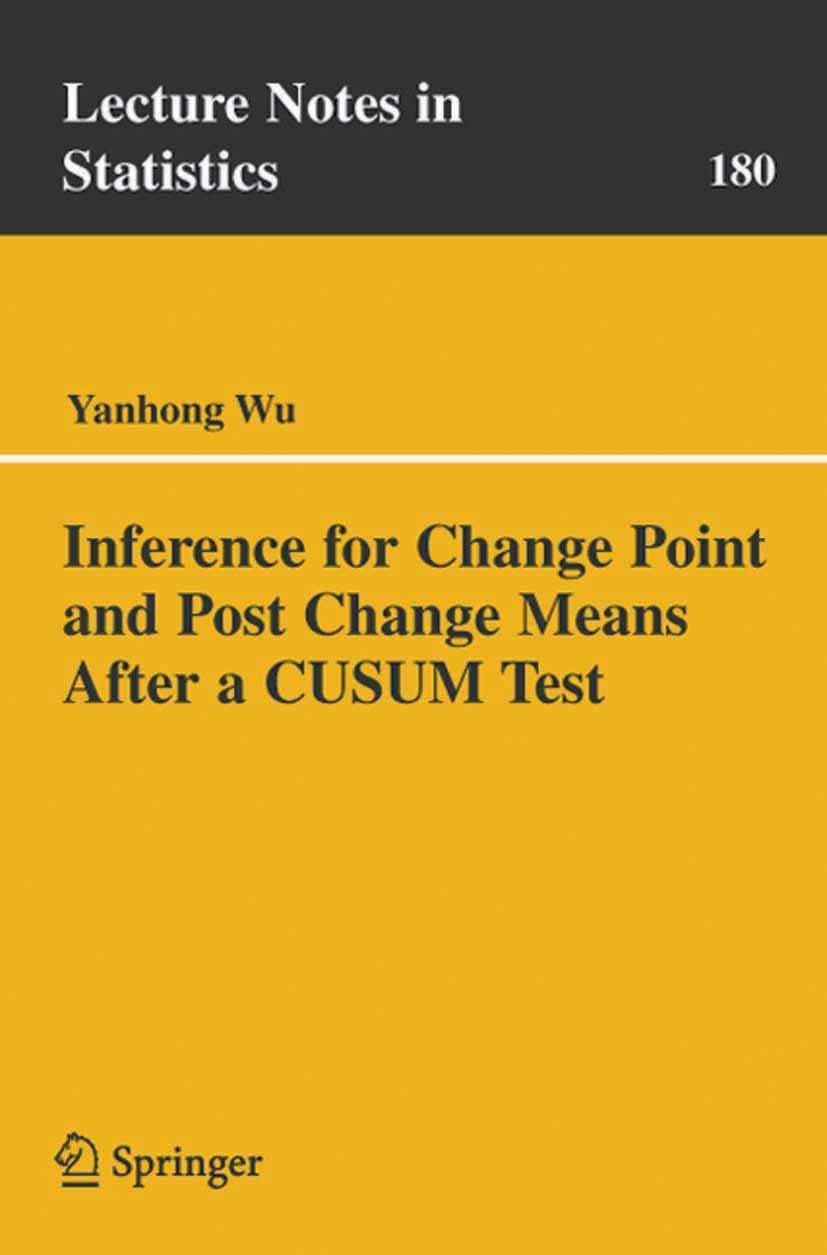
Inference for Change Point and Post Change Means After a CUSUM Test (Lecture Notes in Statistics, 180)
Book Details
- Author
- Yanhong Wu
- Publisher
- Springer
- Format
- Paperback
- Language
- English
- Category
- Econometrics & Statistics
- Condition
- New
- ISBN-13
- 9780387229270
- ISBN-10
- 0387229272
Free U.S. shipping on all orders. International shipping is calculated at checkout.
ISBN: 0387229272
Author: Wu, Yanhong
Condition: New
The change-point problem has attracted many statistical researchers and practitioners during the last few decades. Here, we only concentrate on the sequential change-point problem. Starting from the Shewhart chart with app- cations to quality control [see Shewhart (1931)], several monitoring procedures have been developed for a quick detection of change. The three most studied monitoring procedures are the CUSUM procedure [Page (1954)], the EWMA procedure [Roberts (1959)] and the Shiryayev?Roberts procedure [Shiryayev (1963) and Roberts (1966)]. Extensive studies have been conducted on the p- formancesofthesemonitoringproceduresandcomparisonsintermsofthedelay detection time. Lai (1995) made a review on the state of the art on these charts and proposed several possible generalizations in order to detect a change in the case of the unknown post-change parameter case. In particular, a wind- limited version of the generalized likelihood ratio testing procedure studied by Siegmund and Venkatraman (1993) is proposed for a more practical treatment even when the observations are correlated. In this work, our main emphasis is on the inference problem for the chan- point and the post-change parameters after a signal of change is made. More speci?cally, due to its convenient form and statistical properties, most d- cussions are concentrated on the CUSUM procedure. Our goal is to provide some quantitative evaluations on the statistical properties of estimators for the change-point and the post-change parameters.
Have a question?
Inference for Change Point and Post Change Means After a CUSUM Test (Lecture Notes in Statistics, 180)
