


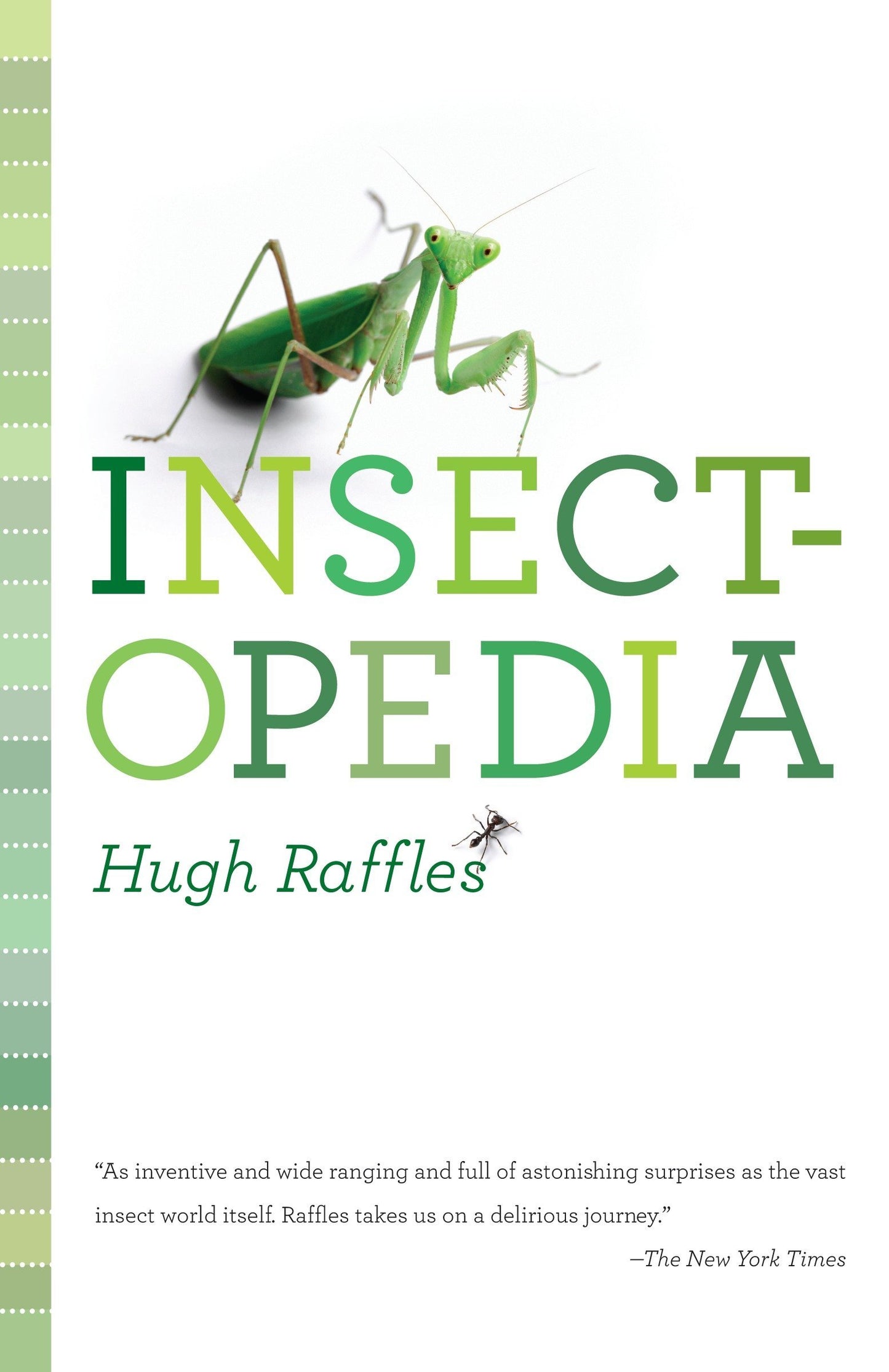
Insectopedia
MIA KARTS BOOKS

Insectopedia
Book Details
- Author
- Hugh Raffles
- Publisher
- Vintage
- Format
- Paperback
- Language
- English
- Category
- Spies & Politics
- Condition
- New
- ISBN-13
- 9781400096961
- ISBN-10
- 1400096960
Free U.S. shipping on all orders. International shipping is calculated at checkout.
ISBN: 1400096960
Author: Raffles, Hugh
Condition: New
Excerpt. Reprinted by permission. All rights reserved.Air1.On August 10, 1926, a Stinson Detroiter SM-1 six-seater monoplane took off from the rudimentary airstrip at Tallulah, Louisiana. The Detroiter was the first airplane built with an electric starter motor, wheel brakes, and a heated cabin, but it was not a good climber, so the pilot leveled off quickly, circled the airstrip and surrounding landscape, held open the specially fitted sticky trap beneath the plane's wing for the designated ten minutes, and soon returned to land. As he touched down, P. A. Glick and his colleagues at the Division of Cotton Insect Investigations of the U.S. Bureau of Entomology and Plant Quarantine ran out to meet him.It was a historic flight: the first attempt to collect insects by airplane. Glick and his associates, as well as researchers at the Department of Agriculture and at regional organizations such as the New York State Museum, were trying to discover the migration secrets of gypsy moths, cotton bollworm moths, and other insects that were munching their way through the nation's natural resources. They wanted to predict infestations, to know what might happen next. How could they contain these insect enemies if they didn't know where, when, and how they traveled?2.Before Tallulah, high-altitude entomology had barely got off the ground. Researchers sent up balloons and kites fitted with hanging nets, climbed up pylons, and pestered lighthouse keepers and mountaineers. But armed now with the new airplane technology, Glick went down to Tlahualilo in Durango, Mexico. There, 3,000 feet above the valley plain, his pilots trapped the pink bollworm moth, a feared invader of the U.S. cotton crop. Face-to-face with the unanticipated scale of his task, Glick wrote tersely that "the pink bollworm moths are carried in the upper air currents for considerable distances."There were only a few flies and wasps in that first trap at Tallulah. But over the next five years, the researchers flew more than 1,300 sorties from the Louisiana airstrip and captured tens of thousands more insects at altitudes ranging from 20 to 15,000 feet. They generated a long series of charts and tables, cataloguing individual insects of 700 named species according to the height at which they were collected, time of day, wind speed and direction, temperature, barometric pressure, humidity, dew point, and many other physical variables. They already knew something about long-distance dispersal. They had heard about the butterflies, gnats, water striders, leaf bugs, booklice, and katydids sighted hundreds of miles out on the open ocean; about the aphids that Captain William Parry had encountered on ice floes during his polar expedition of 1828; and about those other aphids that, in 1925, made the 800-mile journey across the frigid, windswept Barents Sea between the Kola Peninsula, in Russia, and Spitsbergen, off Norway, in just twenty-four hours. Still, they were taken aback by the enormous quantities of animals they were discovering in the air above Louisiana and unashamedly astonished by the heights at which they found them. All of a sudden, it seemed, the heavens had opened.Unmoored, they turned to the ocean, began talking about the "aeroplankton" drifting in the vastness of the open skies. They told each other about tiny insects, some of them wingless, all with large surface-area-to-weight ratios, plucked from their earthly tethers by a sharp gust of wind, picked up on air currents and thrust high into the convection streams without volition or capacity for resistance, some terrible accident, carried great distances across oceans and continents, then dropped with the same fateful arbitrariness in a downdraft on some distant mountaintop or valley plain. They estimated that at any given time on any given day throughout the year, the air column rising from 50 to 14,000 feet above one square mile of Louisiana countryside contained an average of 25 million insects
Have a question?
Insectopedia
