


- Vendor: Mia Karts
Power Series from a Computational Point of View (Universitext)
Free U.S. shipping on all orders. Free international shipping on orders over $99
All orders are dispatched the next business day!
Competitive Pricing You Can Trust — Quality You Can Rely On.
ISBN: 0387965165
Author: Smith, Kennan T.
Condition: New
At the end of the typical one quarter course on power series the students lack the means to decide 2 whether 1/(1+x ) has an expansion around any point 0, or the tangent has an expansion anywhere and the means to evaluate and predict errors. In using power series for computation the main problems are: 1) To predict a priori the number N of terms needed to do the computation with a specified accuracy; and 2) To find the coefficients aO, -.-, a - N These are the problems addressed in the book. Typical computations envisioned are: -6 calculate with error 10 the integrals If/2 J (If/2-x)tan x dx o or the solution to the differential equation 2 y"+(sin x)Y'+x y = 0, y(O) = 0, y'(O) 1, on the interval 0 x 1. This computational point of view may seem narrow, but, in fact, such computations require the understa- ing and use of many of the important theorems of ele- mentary analytic function theory: Cauchy's Integral Theorem, Cauchy's Inequalities, Unique Continuation, Analytic Continuation and the Monodromy Theorem, etc. The computations provide an effective motivation for learning the theorems and a sound basis for understa- ing them. To other scientists the rationale for the vi computational point of view might be the need for ef- cient accurate calculation; to mathematicians it is the motivation for learning theorems and the practice with inequalities, 's, o's, and N's.
Have a question?
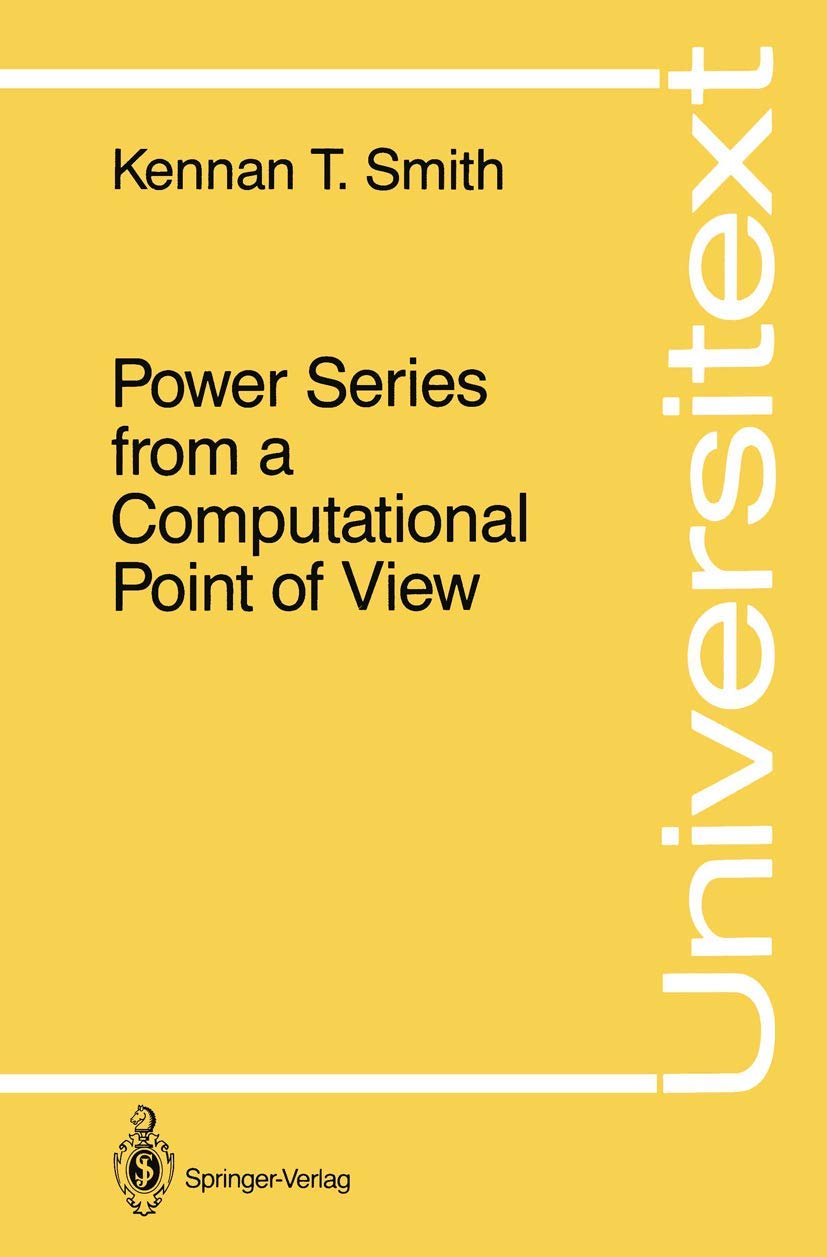
Power Series from a Computational Point of View (Universitext)