

- Vendor: Mia Karts
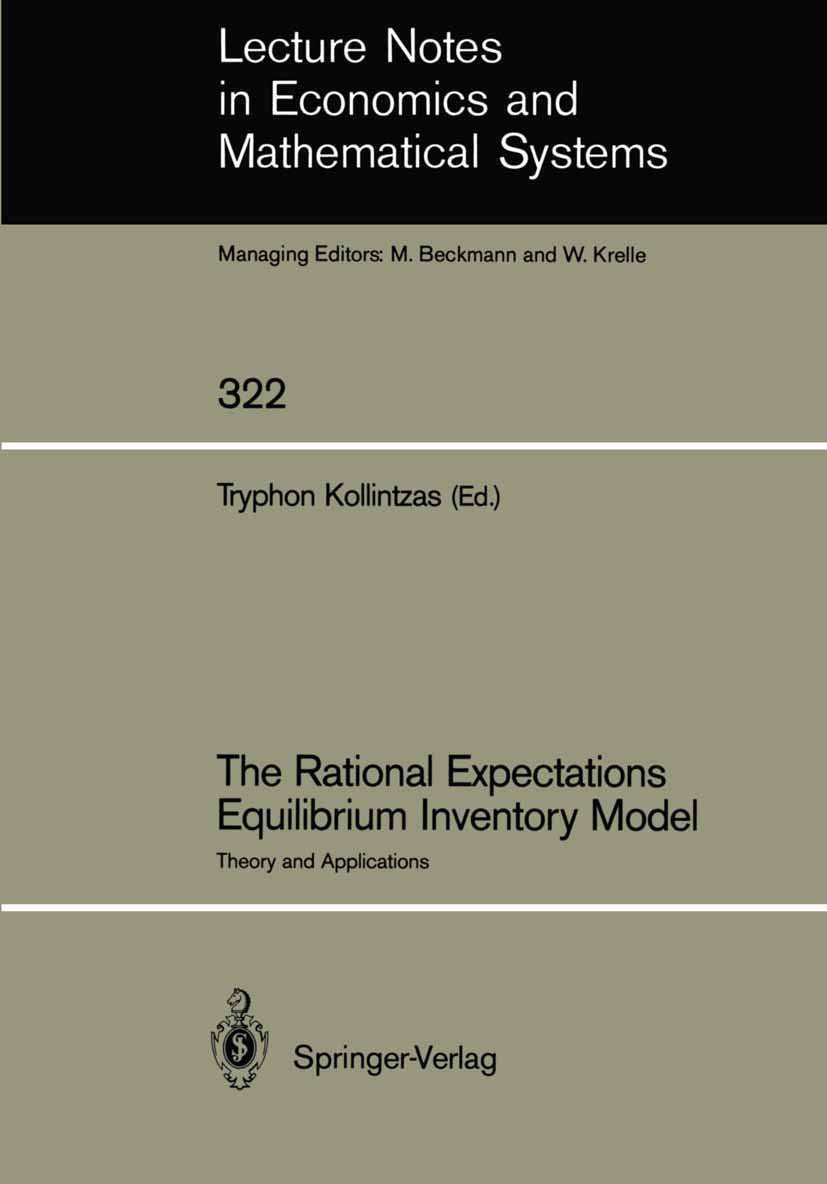
The Rational Expectations Equilibrium Inventory Model: Theory and Applications (Lecture Notes in Economics and Mathematical Systems, 322)
Free U.S. shipping on all orders. Free international shipping on orders over $99
All orders are dispatched the next business day!
Competitive Pricing You Can Trust — Quality You Can Rely On.
ISBN: 0387969403
Author: Kollintzas, Tryphon
Condition: New
This volume consists of six essays that develop and/or apply "rational expectations equilibrium inventory models" to study the time series behavior of production, sales, prices, and inventories at the industry level. By "rational expectations equilibrium inventory model" I mean the extension of the inventory model of Holt, Modigliani, Muth, and Simon (1960) to account for: (i) discounting, (ii) infinite horizon planning, (iii) observed and unobserved by the "econometrician" stochastic shocks in the production, factor adjustment, storage, and backorders management processes of firms, as well as in the demand they face for their products; and (iv) rational expectations. As is well known according to the Holt et al. model firms hold inventories in order to: (a) smooth production, (b) smooth production changes, and (c) avoid stockouts. Following the work of Zabel (1972), Maccini (1976), Reagan (1982), and Reagan and Weitzman (1982), Blinder (1982) laid the foundations of the rational expectations equilibrium inventory model. To the three reasons for holding inventories in the model of Holt et al. was added (d) optimal pricing. Moreover, the popular "accelerator" or "partial adjustment" inventory behavior equation of Lovell (1961) received its microfoundations and thus overcame the "Lucas critique of econometric modelling.
Have a question?
The Rational Expectations Equilibrium Inventory Model: Theory and Applications (Lecture Notes in Economics and Mathematical Systems, 322)
You May Also Like
More in Science & Math