

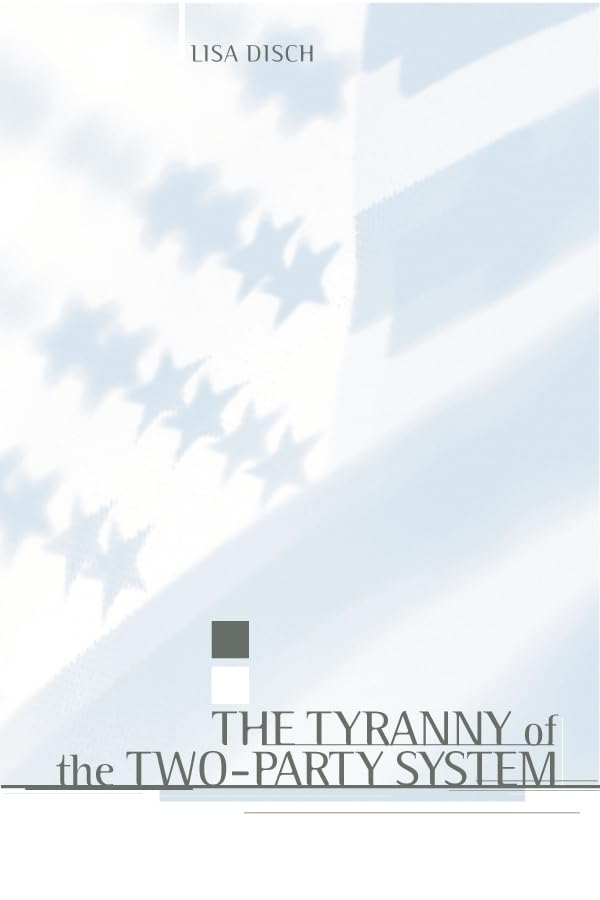
The Tyranny of the Two-Party System
MIA KARTS BOOKS

- Vendor: Mia Karts
The Tyranny of the Two-Party System
Book Details
- Author
- Lisa Disch
- Publisher
- Columbia University Press
- Format
- Hardcover
- Language
- English
- Category
- Political
- Condition
- New
- ISBN-13
- 9780231110341
- ISBN-10
- 0231110340
Free U.S. shipping on all orders. International shipping is calculated at checkout.
ISBN: 0231110340
Author: Disch, Lisa
Condition: New
Review Disch's book is strong and unique as it strays from many of the traps that plague third-party literature. Her book does not focus solely on a single party in an attempt to generalize from a unique example, nor does it fall prey to the "easy answer" syndrome: telling the reader why a third party erupted and why it could no longer retain its electoral viability. Disch presents a refreshingly unconventional take on American party history that is unique within this genre of party literature. -- Spencer Jones - Congress and the PresidencyDisch argues for the legal acceptibility of 'fusion' tickets in which candidates can appear on ballots as nominees of more than one party. - ChoiceFascinating and colorful -- Brian Doherty - Reason[T]his book is a critique of the current partisan organization of American politics, its legal and institutional underpinnings, and a celebration of 'third party' alternatives to the political status quo... Disch provides both an interesting story of one reform effort and an enlightening analysis of how the status quo came to be. -- Keith E. Whittington - Perspectives on Politics Product Description The closely contested presidential election of 2000, which many analysts felt was decided by voters for the Green Party, cast a spotlight on a structural contradiction of American politics. Critics charged that Green Party voters inadvertently contributed to the election of a conservative Republican president because they chose to "vote their conscience" rather than "choose between two evils." But why this choice of two? Is the two-party system of Democrats and Republicans an immutable and indispensable aspect of our democracy? Lisa Disch maintains that it is not. There is no constitutional warrant for two parties, and winner-take-all elections need not set third parties up to fail. She argues that the two-party system as we know it dates only to the twentieth century and that it thwarts democracy by wasting the votes and silencing the voices of dissenters. The Tyranny of the Two-Party System reexamines a once popular nineteenth-century strategy called fusion, in which a dominant-party candidate ran on the ballots of both the established party and a third party. In the nineteenth century fusion made possible something that many citizens wish were possible today: to register a protest vote that counts and that will not throw the election to the establishment candidate they least prefer. The book concludes by analyzing the 2000 presidential election as an object lesson in the tyranny of the two-party system and with suggestions for voting experiments to stimulate participation and make American democracy responsive to a broader range of citizens. From Library Journal Unable to predict either the rise of smack-down artist Jesse Ventura to the Minnesota governorship or the outcome of the 2000 presidential election, some political scientists are retreating to scholasticism. Red flags need to be raised since it is nearly always predictable that when the electoral world disappoints, political scientists will turn to utopian critiques of America's constitutional system or its two-party system-bedrocks of democracy. Despite the catchy title, this book fits into this mode. Disch (political science, Univ. of Minnesota) is the author of Hannah Arendt and the Limits of Philosophy. Her new book grows out of dissatisfaction with modern electoral politics. Disch participated in the disappointing efforts of the Twin Cities Area New Party (TCANP), an offshoot of a leftist alternative to the Democratic Party. She concludes that the two-party system shortchanges the promise of American democracy. A broader historical perspective may have proven useful, however. Many readers may find this critique too utopian and abstract; its title promises an overview of what is wrong with America's two-party system, but it is instead a case study of presidential politics in St. Paul, MN. An optional purchase for
Have a question?
The Tyranny of the Two-Party System
You May Also Like
More in Politics & Society